Area guide
Living in Sapporo: Wards, Rent, Snow, Land & Daily Life
The short answer
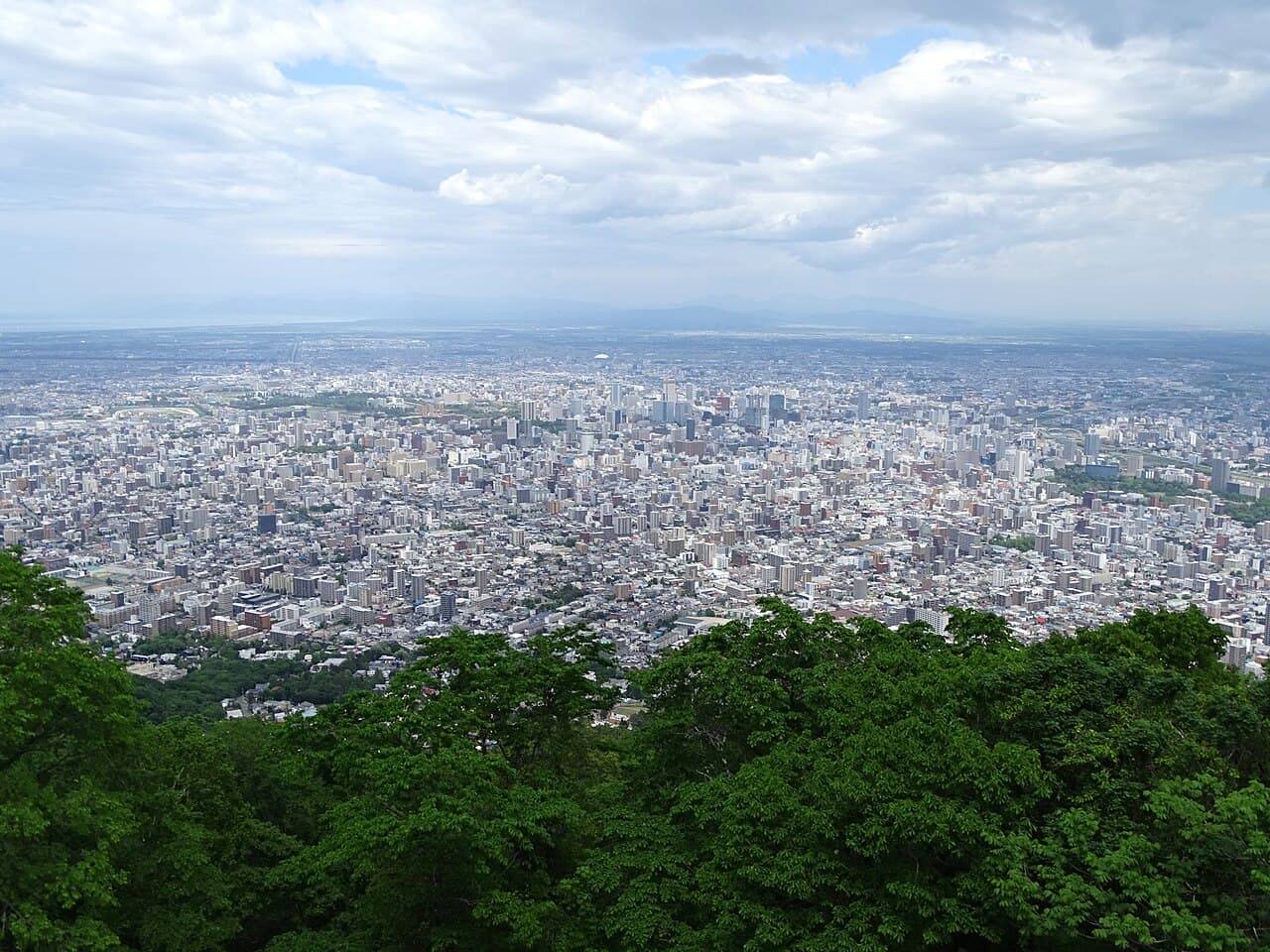
Sapporo (札幌市, about 1.96 million people) is a big city built for snow: most people live in flats, owners and renters are roughly equal in number, and lying snow usually stays from early December to early April. Private rents averaged ¥54,678 a month in the 2023 national housing survey. The 2026 official land price for residential areas averaged ¥117,400/m², up 1.1% on a year earlier, a much slower rise than the year before.
- It suits people who want a large city with a subway and big hospitals, and who are ready to live with real snow. It also suits families who want a detached house: in Kiyota, Teine and Minami wards, most homes are detached houses.
- It suits less people who dislike driving or walking on ice, people who want a mild winter, or anyone who wants a large foreign community: registered foreign residents are about 1.3% of the population.
- Before you sign, check the exact address on the city's earthquake and flood maps, ask how the building handles snow and frozen pipes, and learn your ward's rubbish rules. In Sapporo, rubbish goes out on the morning of collection day.
We don't list properties, recommend agents or give investment advice. Every number below comes from a public source, with the date it describes and a link.
Sapporo in numbers
Sapporo City estimated its population at 1,961,890 on 1 September 2026 (Sapporo City estimated population, 2026). The city notes that figures from October 2025 onward are based on the preliminary 2025 census and may be revised (estimated population page). The city covers 1,121.26 km² and is split into ten wards: Chuo, Kita, Higashi, Shiroishi, Atsubetsu, Toyohira, Kiyota, Minami, Nishi and Teine (Sapporo City: overview). The ward office is where you register your address and handle most paperwork.
The resident register counted 25,580 foreign residents on 1 September 2026, out of 1,953,468 registered residents (Sapporo City resident register, 2026). Chuo ward had the most, 5,154.
Land and homes
What land costs, and which way it is moving
Japan's official land price, chika kōji (地価公示, the government's annual appraisal of standard plots as of 1 January), is the public benchmark. The government defines it as a price favouring neither seller nor buyer. Sapporo City's summary of the 2026 results covers 468 survey plots in the city, 304 of them residential (Sapporo City, 2026 Land Price Publication summary):
| Use | Average price (¥/m², 1 Jan 2026) | Average change on a year earlier |
|---|---|---|
| Residential | 117,400 | +1.1% |
| Commercial | 480,600 | +4.6% |
The rise has slowed sharply. In the same summary, residential land rose 2.9% in 2025 and 1.1% in 2026. Every ward's residential rise was smaller than the year before. Teine went from rising to flat, and Kiyota went from rising to falling. Ward by ward (same PDF, table 11):
| Ward | Residential average, ¥/m² (1 Jan 2026) | Change |
|---|---|---|
| Chuo | 249,000 | +2.5% |
| Toyohira | 154,700 | +1.8% |
| Nishi | 126,900 | +1.8% |
| Shiroishi | 122,900 | +1.8% |
| Higashi | 118,500 | +1.9% |
| Atsubetsu | 117,500 | +0.7% |
| Kita | 96,500 | +0.5% |
| Kiyota | 79,600 | −0.3% |
| Teine | 75,000 | 0.0% |
| Minami | 55,200 | +0.3% |
The prefecture's own survey (chika chōsa, as of 1 July 2026, 85 residential plots in the city) shows the same slowdown: ¥109,500/m², +0.7% (Sapporo City, 2026 prefectural land price survey summary). The two surveys use different plots, so compare each survey's change, not the two averages.
Two cautions. First, these are averages of appraised survey plots, not what any single plot or house will cost. You can look up individual survey points on the national map at MLIT's Real Estate Information Library. Second, a past rise tells you nothing about future returns. We don't give investment advice.
What rent costs
The best public rent figure for the whole city comes from the national Housing and Land Survey (住宅・土地統計調査), taken every five years. Its 2023 results (as of 1 October 2023) are published for the city and each ward in table 112-2 on e-Stat (e-Stat, 2023 Housing and Land Survey, table 112-2). For private rental homes (min'ei shakuya, 民営借家), excluding homes with zero rent:
- Average rent: ¥54,678 a month. Among homes that pay common or management fees, those fees averaged ¥4,838.
- About 68% of the city's 409,600 private rentals fell between ¥40,000 and ¥80,000 a month.
By ward, the average private rent ranged from ¥50,664 in Minami to ¥62,609 in Chuo. Atsubetsu came in at ¥58,593, Kiyota at ¥54,645, Teine at ¥54,578, Nishi at ¥54,170, Toyohira at ¥53,367, Kita at ¥52,117, Shiroishi at ¥52,085 and Higashi at ¥51,429 (same table). The gap between wards is much smaller than the gap in land prices. These are survey estimates from 2023. They cover every size of home, and the city's own summary puts the average private rental at about 45 m² (Sapporo City, 2023 Housing and Land Survey summary). Today's asking rents may differ. Use these figures to compare wards, not to predict the rent on a particular flat.
Rental portals publish their own "average rent in Sapporo" figures. Those are averages of the flats listed on that portal, not public statistics, so we don't put them next to these numbers. For how Japanese leases work, see our guides to renting in Japan and move-in costs.
What kind of home you'll live in
The same 2023 survey shows a city of flats, with owners and renters in roughly equal numbers. Of 967,400 occupied homes, 64.3% were in apartment buildings (kyōdō jūtaku) and 33.8% were detached houses. 49.4% were owner-occupied and 47.2% rented (Sapporo City summary). The wards differ a lot. From the prefecture's ward tables for the same survey, flats made up about 89% of homes in Chuo and about 75% in Shiroishi and Toyohira. Detached houses made up about 68% in Kiyota, 62% in Teine and 54% in Minami (Hokkaido Government, 2023 Housing and Land Survey municipal tables).
Winter, as a resident lives it
How much snow, and how cold
The Japan Meteorological Agency's climate normals for Sapporo (1991–2020) give an average of 479 cm of snowfall a year. In a typical winter, the deepest snow on the ground reaches 97 cm. January averages −3.2°C, with an average daily low of −6.4°C and an average daily high of −0.4°C (JMA, Sapporo climate normals). The city says the first snow usually falls in late October and lying snow typically stays from early December to early April (Sapporo City: overview). Winters vary: the city's pocket statistics record 517 cm of snowfall and a deepest snow of 112 cm for October 2025 to May 2026 (Sapporo City pocket statistics 2026).
Who clears the snow, and what the city asks of residents
In fiscal 2025 the city ploughed 5,465 km of roads and 3,048 km of pavements, and hauled snow away from 1,398 km of roads (pocket statistics). On most residential streets, the plough pushes snow to the sides rather than removing it. The city's winter rules and manners for residents (Sapporo winter rules and manners):
- Clearing your own entrance. The city asks each household to deal with the snow the plough leaves in front of its door or garage, even where the pavement is heated or the household pays a private snow service.
- Not pushing snow from your property onto the road. This is the one rule on the list that is a legal ban: the city cites the Road Traffic Act (article 76) and the Road Act (article 43).
- Not parking on the street. The city asks residents not to, because parked cars can stop the plough from clearing the road.
- Putting rubbish out on the morning of collection day, not the night before. The city says bags left overnight get in the way of snow clearing.
Hauling snow away from residential streets is largely organised by the neighbourhood. The city says it cannot haul snow from every residential street, so it runs two support schemes. The schemes cover about 70% of residential streets (about 2,600 km), and 1,200 to 1,300 groups apply each year (Sapporo City: snow hauling support). In the main scheme, the Partnership scheme, the applicant is normally a neighbourhood association (chōnaikai, 町内会) or a local snow-clearing group. The neighbourhood has to agree to take part, the haul happens once a season, and on roads narrower than 10 m the neighbourhood pays a fixed share: ¥516,400 per km for the standard clearance in fiscal 2025. The city pays the rest. After heavy snow on 25 January 2026, the city cancelled these hauls and switched to emergency hauling of residential streets (Sapporo City: Partnership snow hauling). So when you choose a street, ask whether and how it gets snow hauled away.
Frozen pipes
The city water bureau warns that water pipes most often freeze from December to February, especially when the outside temperature falls to −4°C or below, when you are away, or after days that stay below freezing. It recommends draining the pipes with the building's drain valve (mizunuki-sen, 水抜き栓). The bureau does not repair frozen pipes itself: you call a designated contractor and pay for the repair (Sapporo City Waterworks Bureau). Ask your landlord or agent to show you where the drain valve is before winter.
Heating
We found no official figure for what it costs to heat a typical home in Sapporo. The closest public number is household spending on kerosene (灯油). The national Family Income and Expenditure Survey puts Sapporo households of two or more people at an average of ¥71,654 a year on kerosene (2023–2025 average), the second highest of the cities surveyed. The national average is ¥15,094 (Statistics Bureau, household spending by city; table). This is an average across all households, including those that heat with gas or electricity. It doesn't cover single-person households. Ask how a flat is heated, and which fuel it uses, before you sign.
Hazards: check the address, not the city
Earthquakes and liquefaction
On 6 September 2018, the Hokkaido Eastern Iburi Earthquake brought shaking of seismic intensity 6-lower to Higashi ward. The city says this was the first time since records began in 1923 that Sapporo had recorded intensity 5 or above. The earthquake also triggered a blackout across Hokkaido affecting about 2.95 million homes (Sapporo City: remembering the 2018 earthquake). Some of the worst ground damage in the city was in the Satozuka district of Kiyota ward. Liquefaction caused large amounts of soil to flow, the ground sank by more than 2 m, and more than half the houses in the area were fully or partly destroyed. Repairs to the ground and roads were finished in March 2020, and all work was finished in September 2021 (Sapporo City: Satozuka district).
The city's earthquake hazard map (地震防災マップ) shows, for each ward, the expected shaking, the liquefaction risk in four levels and the expected rate of total house collapse. It combines five scenario earthquakes from the city's 2021 damage estimate (Sapporo City earthquake hazard map). The city also publishes a map of large filled land (大規模盛土造成地マップ), meaning valleys and slopes filled in to build housing. The city says being on the map doesn't necessarily mean a site is dangerous in an earthquake. It also warns that some large filled land may exist that the map doesn't show, so a site missing from the map isn't proof it wasn't filled (Sapporo City: large-scale filled land).
Flooding
The city's flood hazard map (浸水ハザードマップ) shows expected flood depth from rivers and from drains overflowing, under the largest rainfall it considers possible. The city warns that areas left uncoloured are not guaranteed to stay dry. It also says no storm-surge flood zone is currently designated in Sapporo (Sapporo City flood hazard map). All the city's maps can be searched by address on its map service, linked from the hazard map index (Sapporo City hazard maps). The site is in Japanese. Check your prospective address on it before signing.
We make no claims about any particular neighbourhood's risk. The map is the authority, and it changes.
The ten wards, from a resident's point of view
These are short notes built from the public numbers above. It isn't a ranking, and we have no properties to sell you in any of them. Populations are the city's estimates for 1 September 2026 (estimated population).
- Chuo (256,178 people): the centre, including City Hall. It has the highest residential land prices (¥249,000/m² in 2026) and the highest private rents (¥62,609 in 2023), and almost nine homes in ten are flats.
- Kita (284,843) and Higashi (261,161): the two most populous wards. Kita's residential land average (¥96,500/m²) was below the city average in 2026. Higashi is where the city recorded intensity 6-lower shaking in the 2018 earthquake.
- Shiroishi (211,195) and Toyohira (232,288): mostly flats (about three in four homes). Toyohira had the second-highest residential land average in 2026 (¥154,700/m²).
- Nishi (218,003) and Teine (138,336): Nishi is close to the city average on land price and rent. Teine is mostly detached houses, and its residential land price was flat in 2026.
- Atsubetsu (121,026) and Kiyota (107,094): Atsubetsu had the second-highest private rent in 2023 (¥58,593). Kiyota has the highest share of detached houses and owner-occupiers in the city (about 76% owner-occupied), and it is where Satozuka is. Check the earthquake and filled-land maps with particular care here.
- Minami (131,766): it reaches into the mountains, and the city's highest point, Mount Yoichi (1,487.9 m), is in this ward (Sapporo City: overview). It had the lowest residential land average in 2026 (¥55,200/m²) and the lowest private rents.
Daily life
Getting around
The city subway has three lines, 48.0 km in total: the Namboku Line (14.3 km), the Tozai Line (20.1 km) and the Toho Line (13.6 km). It runs on rubber tyres, and the city describes it as the backbone of public transport that the snowy, cold climate doesn't disrupt. The elevated section of the Namboku Line (Hiragishi to Makomanai) is covered by an aluminium shelter against snow (Sapporo City Transportation Bureau: subway overview). A streetcar runs a loop line. The city's transportation bureau owns the tracks and cars, and since April 2020 a transport corporation funded by the city has run the service (streetcar operation). The city's foreign-resident help desk explains tickets and the SAPICA IC card in English. It also notes that at Sapporo Station you have to exit the gates to change between the Namboku and Toho lines (SAPPORO HELP DESK: transportation). For flights, the city says rapid trains leave New Chitose Airport every 15 minutes and reach JR Sapporo Station in 37 minutes (Sapporo City: overview).
Rubbish goes out in the morning
Household waste goes out by 8:30 a.m. on your area's collection day, never the night before. It goes to the rubbish station (gomi station) your household shares with neighbours. The city collects nine categories. Burnable and non-burnable waste go in paid, city-designated bags. Burnable waste is collected twice a week (Sapporo City: rubbish stations). If you break the rules, your bag gets a warning sticker and is left behind. The city also asks the households that use each station to keep it clean and to clear its snow. The city publishes an English sorting guide (Sapporo City: foreign-language waste guides). The foreign-resident help desk lists a sorting app with English and an English leaflet on the basic rules (SAPPORO HELP DESK: housing and daily life).
Doctors and hospitals in your language
- Sapporo Medical Communication Hotline: 011-211-2121. An operator can interpret by phone while you are at a hospital, 24 hours a day, every day. The service is free (you pay for the call) and offers 32 languages. On weekdays from 9 a.m. to 5 p.m., the operator can also make hospital appointments for you (SAPPORO HELP DESK: medical).
- For sudden illness or injury, #7119 is the emergency medical consultation line. It helps you decide whether to see a doctor or call an ambulance (same page). For an ambulance, call 119.
- For meetings at schools, nurseries and ward offices, the Sapporo Community Interpreters service sends interpreters in eight languages. Requests are usually filed by the agency or school, and need at least five days' notice. Contact the Sapporo International Communication Plaza Foundation first (SAPPORO HELP DESK: interpretation).
Schools for foreign children
At municipal elementary and junior high schools, tuition and textbooks are free, but school lunches and materials are paid for. If your address is registered, the city posts a health check-up form in October of the year before your child starts elementary school, and a school enrolment notice in January. If the notice doesn't arrive, contact the Sapporo Board of Education (011-211-3821). The city sends instructors into municipal schools to help children who are learning Japanese. The city's international foundation publishes an elementary school enrolment guidebook in English and other languages, and runs a free study-support session once a month (SAPPORO HELP DESK: education). If you are considering an international school, check fees, curriculum and waiting lists with the school directly. We haven't reviewed them.
One place to start
For registering your address, health insurance, tax, the rest of the paperwork, and winter life, the city's SAPPORO HELP DESK for Foreign Residents has an English guide and takes questions (SAPPORO HELP DESK).
History and culture, as a resident lives it
Hokkaido was home to the Ainu people before the Meiji government began building Sapporo in 1869. The city gives two Ainu-language explanations of the name, among others: sari poro pet, "a river with a vast reed bed", and sat poro pet, "a large, dry river" (Sapporo City: overview). The city's Ainu Culture Exchange Centre, Sapporo Pirka Kotan ("Sapporo's beautiful village") in Koganeyu, Minami ward, displays about 300 items of traditional clothing and tools that visitors can pick up and handle (Sapporo City: Pirka Kotan).
The modern city was planned. In 1869 the Meiji government set up the Kaitakushi (開拓使, the Hokkaido Development Commission) and began building its headquarters here. In 1871 it laid out a grid about 4 km square. Odori divided the town north from south, and the Sōsei River divided it east from west. Government offices went to the north, shops and houses to the south (Sapporo City: history of winter). Central addresses still follow the grid: City Hall is at Kita 1-jō Nishi 2-chōme, "North 1, West 2". The first settler-soldiers (tondenhei) arrived in 1875. Sapporo became a city in 1922 and a designated city in 1972 (Sapporo City: overview), the year it hosted the Winter Olympics (history of winter).
For a resident, the grid and the snow meet in the neighbourhood association. The city's page on chōnaikai lists the schemes they take part in: grants for rubbish stations, the Partnership snow hauling scheme, subsidies for disaster-prevention equipment, street lights and more (Sapporo City: neighbourhood associations). On a street that pays towards its own snow hauling, ask your neighbours or landlord which association covers it and how it works before your first winter.
For what to see and do, go to our sister site: Sapporo events, the Sapporo Snow Festival, YOSAKOI Soran and the Sapporo Autumn Fest.
Renting or buying: the process
The rules are the same nationwide, and our step-by-step guides apply unchanged in Sapporo:
- Renting: how leases, key money and guarantors work and what you pay at move-in
- Buying: can foreigners buy property in Japan?, every fee and tax when you buy, why your agent may also represent the seller, what a judicial scrivener does, and, for older plots, what "cannot be rebuilt" means
- Empty houses: how akiya banks work
- Non-residents who buy: the FEFTA Form 22 reporting rule
About this guide
SUMIKA is an independent guide. We don't list or broker property, we have no commercial relationship with any agent or developer, and nothing here is investment, legal or tax advice. Land prices and rents are dated public statistics. They describe areas, not individual homes, and they change. Before you commit, check the current figures, the hazard maps for the exact address, and the lease or sales contract with a licensed professional. Figures checked on 25 September 2026.
Key facts
- Population
- 1,961,890 (Sapporo City estimate, as of 1 Sept 2026); 25,580 registered foreign residents (as of 1 Sept 2026). Area 1,121.26 km², 10 wards
- Official land price, residential
- City average ¥117,400/m², +1.1% year on year (Land Price Publication, as of 1 Jan 2026). Ward averages range from ¥55,200 (Minami) to ¥249,000 (Chuo)
- Official land price, latest survey
- Prefectural land price survey: residential average ¥109,500/m², +0.7% (as of 1 July 2026; different plots from the January figures)
- Private rent
- Average ¥54,678/month excluding zero-rent homes; common/management fees ¥4,838 where charged (Housing and Land Survey, as of 1 Oct 2023). Ward averages ¥50,664 (Minami) to ¥62,609 (Chuo)
- Housing stock
- 64.3% of occupied homes in apartment buildings, 33.8% detached; 49.4% owner-occupied, 47.2% rented (as of 1 Oct 2023)
- Snow and cold
- Average annual snowfall 479 cm; typical deepest snow 97 cm; January mean −3.2°C (JMA normals 1991–2020)
- Snow clearing
- City ploughed 5,465 km of roads and hauled snow from 1,398 km in fiscal 2025. The city asks residents to clear their own entrances; pushing snow onto the road is banned by law (Road Traffic Act art. 76, Road Act art. 43)
- Heating fuel
- Households of 2+ people spent ¥71,654 a year on kerosene on average (national ¥15,094; Family Income and Expenditure Survey, 2023–2025 average)
- Hazards to check
- City earthquake map (shaking, liquefaction, house collapse, by ward), large-scale filled land map, flood map. Check by address
- Subway
- 3 lines, 48.0 km (Namboku, Tozai, Toho), plus a streetcar loop (as of 25 Sept 2026)
- Rubbish
- Out by 8:30 a.m. on collection day; 9 categories; burnable and non-burnable in paid designated bags (as of 25 Sept 2026)
- Medical interpreting
- Sapporo Medical Communication Hotline 011-211-2121: free, 24 hours, 32 languages (as of 25 Sept 2026)
FAQ
- How much is rent in Sapporo?
- The latest public figure is the 2023 Housing and Land Survey: private rental homes in Sapporo averaged ¥54,678 a month, excluding homes with zero rent. Where common or management fees were charged, they averaged ¥4,838. About 68% of private rentals fell between ¥40,000 and ¥80,000. Ward averages ran from ¥50,664 (Minami) to ¥62,609 (Chuo). These are survey averages from 2023 across all home sizes. Current asking rents for a particular flat may differ.
- How much snow does Sapporo get?
- The Japan Meteorological Agency's normals for 1991–2020 give 479 cm of snowfall in an average year. The deepest snow on the ground reaches 97 cm in a typical winter, and January averages −3.2°C. Winters vary: the city recorded 517 cm of snowfall and a deepest snow of 112 cm for October 2025 to May 2026.
- Do I have to clear snow myself in Sapporo?
- Partly. The city ploughs the roads, but on most residential streets the plough pushes snow to the sides. The city asks each household to clear the snow left at its own entrance and garage. Pushing snow from your property onto the road is banned by law (Road Traffic Act article 76, Road Act article 43). Hauling snow away from residential streets is mostly arranged through neighbourhood associations, which pay part of the cost.
- Are land prices in Sapporo going up?
- Yes, but much more slowly. The 2026 Land Price Publication (as of 1 January) put the city's residential average at ¥117,400/m², up 1.1% after 2.9% the year before. The July 2026 prefectural survey showed +0.7%. Kiyota ward's average fell slightly and Teine's was flat. These describe the past, not a forecast, and this isn't investment advice.
- Is Sapporo at risk from earthquakes?
- The 2018 Hokkaido Eastern Iburi Earthquake brought intensity 6-lower shaking to Higashi ward. Liquefaction in the Satozuka district of Kiyota ward made the ground sink by more than 2 m. The city publishes an earthquake map for each ward (shaking, liquefaction, house collapse) and a map of large filled land. Check the exact address before you rent or buy.
- Can I see a doctor in English in Sapporo?
- Yes, with help. The Sapporo Medical Communication Hotline (011-211-2121) interprets by phone at hospitals, free, 24 hours a day, in 32 languages, and on weekdays from 9 a.m. to 5 p.m. it can make hospital appointments for you. For advice on whether to go to hospital, call #7119. For an ambulance, call 119.
This article is general information, not legal, tax or investment advice. Rules, taxes and procedures change and every situation differs — confirm with the official sources linked here and consult a licensed professional (lawyer, tax accountant, judicial scrivener or licensed agent) for your own case. We sell nothing and list no properties (see /how-we-review).