Guide
Saikenchiku Fuka (再建築不可): What "This Property Cannot Be Rebuilt" Actually Means
The short answer
Some of the cheapest houses in Japan — the ones behind a viral ¥5 million listing — are cheap because of one specific, checkable legal fact: the site is saikenchiku fuka (再建築不可, literally "cannot be rebuilt"). This isn't a vague warning about "old buildings." It is a direct consequence of Japan's road-frontage rule (接道義務, setsudou gimu) under the Building Standards Act (建築基準法), and it means that if the existing building is ever torn down, the law will generally not let you put a new one up in its place — only patched, repaired, or partially renovated within limits.
The rule: 2 metres of frontage on a 4-metre road
Article 43 of the Building Standards Act requires that a building site have at least 2 metres of frontage on a "road" as defined by Article 42 — and Article 42 generally defines a qualifying road as at least 4 metres wide (public roads, roads under city planning law, and certain other categories, including privately built roads that have received an official "position designation," 位置指定道路). This 4m/2m combination is the whole rule in one sentence: no qualifying road frontage, no building permit for new construction.
The purpose, per the Ministry of Land, Infrastructure, Transport and Tourism (MLIT), is blunt and practical: a fire truck or ambulance has to be able to reach the building, and residents need a way out in an emergency. A site down a lane too narrow for that is treated as a safety problem, not a technicality.
This applies within city planning areas and quasi-city planning areas (都市計画区域・準都市計画区域) — which covers the overwhelming majority of Japan's cities and towns. Some remote rural land sits outside these zones entirely, where the road-frontage rule doesn't apply the same way; if you're looking at genuinely rural akiya, the road situation is one of the first things to ask the municipality about, not assume from the city rule.
The narrow-road workaround: 42条2項 "deemed roads" and the setback
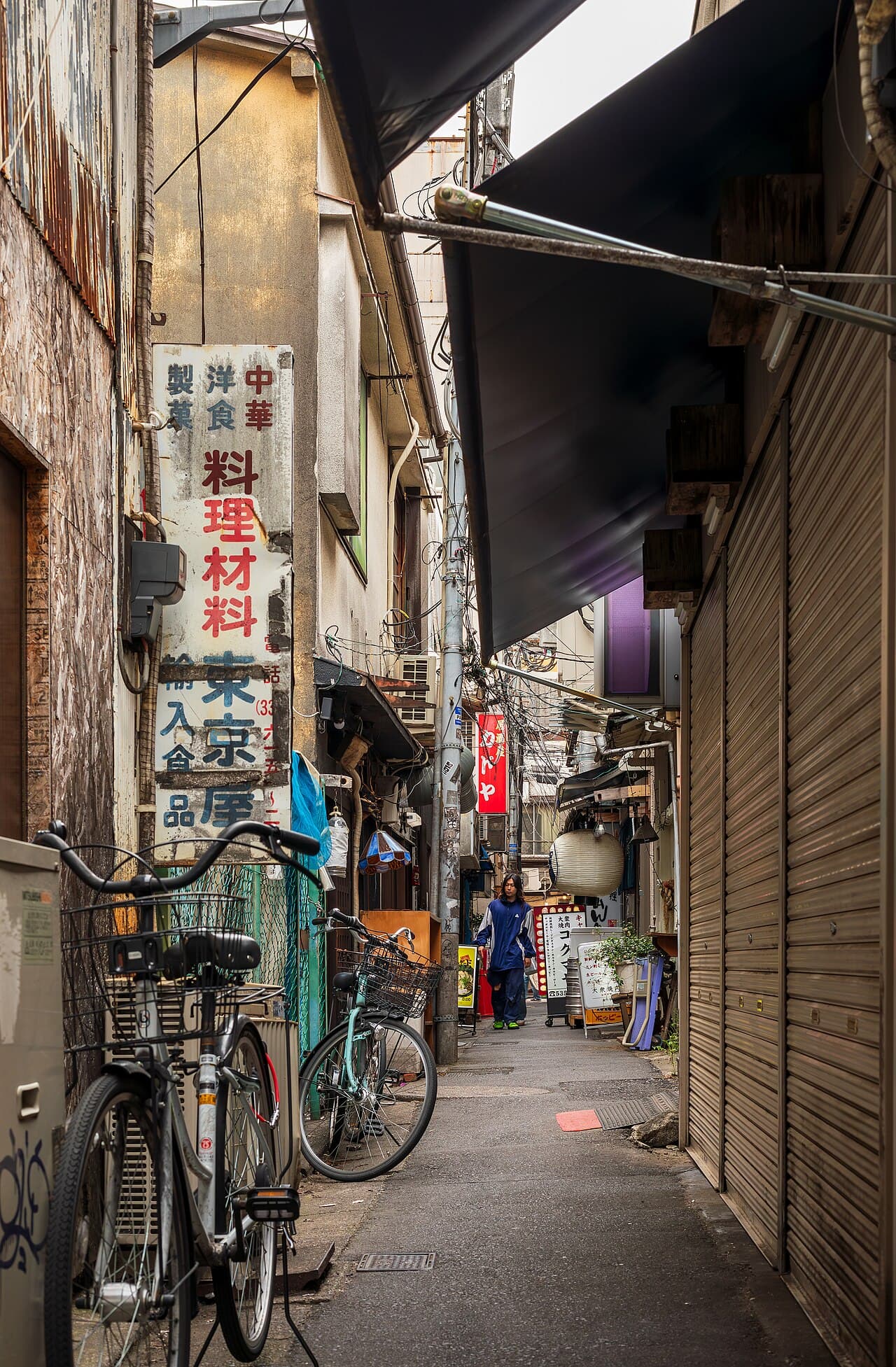
Japan was built up densely long before this 4-metre standard existed, so a huge number of ordinary streets — especially older Tokyo neighbourhoods — are narrower than 4 metres. The law handles this with Article 42 Paragraph 2 (42条2項道路): a road that already existed and had buildings along it before the area came under the Building Standards Act, narrower than 4m, can be designated by the local government as a road anyway — but with a catch.
Every time a site along one of these roads is rebuilt, the owner must set back (セットバック) their new building line to a point 2 metres from the centre of the road, not from its current edge. As one city's official guidance puts it: if both sides of the road eventually set back 2 metres from the centreline, the road reaches the full 4 metres over time, one rebuild at a time. Land inside the setback strip can't be counted in your buildable floor area calculations either, so a 42条2項道路 site is legally buildable — but often smaller and slower to develop than the listing photo suggests.
When there's genuinely no way to a qualifying road: the property really is saikenchiku fuka
Some sites have no frontage on any Article 42 road at all — a landlocked plot behind other houses, reached only by a private path too narrow to qualify, is the classic case. For these, in principle:
- A full "scrap and rebuild" — demolishing and constructing a new building — cannot get the building confirmation (建築確認) it needs.
- Repairs, maintenance, and some renovation within the existing footprint are often still possible, since you're not applying for new construction. Exactly where that line falls is a case-by-case, technical question for the local building department, not something to assume from a blog.
- Resale and financing get harder, because the next buyer inherits the same restriction, and Japanese lenders are typically cautious about collateral they can't easily rebuild.
None of this makes the property worthless or a scam — plenty of saikenchiku fuka houses are lived in for decades. It does mean the discount you're seeing reflects a real, structural limitation, not just an old kitchen.
The narrow exception: 43条2項 certification or permission
Since a 2018 reform, sites that don't meet the standard frontage rule can sometimes still get permission to build, through one of two routes under Article 43 Paragraph 2:
- 43条2項1号 (nintei, certification) — for cases that meet specific pre-set criteria (for example, fronting a public path of a certain width, for a limited building size), the local building authority (特定行政庁) can certify the site directly, without further committee review.
- 43条2項2号 (kyoka, permission) — a broader, case-by-case route (for example, a site with generous open space around it), which requires the same authority's approval and the consent of the local building review board (建築審査会) — a slower, less certain process.
This is a real path for some properties, confirmed case by case by the city or ward — it is not a right you can assume into a purchase, and it is exactly the kind of thing to have a licensed professional check before you commit to a saikenchiku fuka property expecting to rebuild later.
How to actually find out before you buy
- Ask directly what road the site fronts, and whether it's recognised under Article 42 — a licensed agent is required to cover this in the pre-contract explanation of important matters, but asking early beats reading the fine print at signing.
- Call the municipality's building permit division (建築指導課 or a similarly named office) and ask them to confirm the site's road status — this is public information they can generally check for a specific address.
- If the road looks narrow in photos, assume nothing — narrow doesn't automatically mean non-compliant (42条2項 roads are narrow and legal to build on, with the setback); it just means you check rather than guess.
This sits alongside, not instead of, the ordinary closing costs of any Japanese purchase, and it's one of the practical realities worth knowing before you fall for a cheap listing on an akiya bank. Ownership itself has no nationality restriction — see our piece on whether foreigners can buy property in Japan — the road-frontage rule applies identically regardless of who is buying.
This explains the general legal mechanism as of 2026-07-16 and is not legal advice. Whether a specific site qualifies as a recognised road, whether a 42条2項 setback applies, and whether a 43条2項 certification or permission is available are technical, site-specific determinations — confirm them with the municipality's building department, a licensed agent, or an architect before you rely on them.
FAQ
- Does 'saikenchiku fuka' mean the house is falling down?
- No — it's a separate legal fact about the site's road access, not a statement about the building's physical condition. A saikenchiku fuka property can be perfectly livable; the restriction only bites if you try to fully demolish and rebuild.
- Can a saikenchiku fuka site ever become rebuildable?
- Sometimes, through a 42条2項 road setback over time, or a case-by-case 43条2項 certification or permission from the local building authority — neither is automatic, and both need confirmation from the municipality or a professional before you buy expecting one.
- Is this only a problem for cheap rural akiya?
- No — plenty of narrow, dense city backstreets in older Tokyo neighbourhoods have the same issue; it's a road-width problem, not a rural-versus-urban one.
This article is general information, not legal, tax or investment advice. Rules, taxes and procedures change and every situation differs — confirm with the official sources linked here and consult a licensed professional (lawyer, tax accountant, judicial scrivener or licensed agent) for your own case. We sell nothing and list no properties (see /how-we-review).